This blog is used to highlight things I like and stuff I did. A digital diary for sharing.
Showing posts with label Meoramri. Show all posts
Thursday, February 23, 2012
The Tallest Minaret on Earth (see Times Special)
If you visit the Hassan II Mosque just to see the world's tallest minaret, you're selling yourself way short. Built on a promontory on the edge of Casablanca, the Hassan II Mosque can hold 25,000 worshippers and another 80,000 on its grounds. Half of the mosque lies on reclaimed land over the Atlantic Ocean and part of the mosque's floor is made of glass so worshippers can kneel and pray directly over the sea. But at 689 ft. (210 m) the Hassan II's minaret is an important architectural entity in its own right. Minarets traditionally serve as the vantage point from which the calls to prayer are made five times a day. The Hassan II's minaret is not only the tallest minaret in the world but also the tallest structure in Morocco. At night, lasers shine a beam from the minaret toward Mecca "to point the way to God," ensuring that visitors to Casablanca and the surrounding areas always know the direction of Islam's holiest city.
Wednesday, February 22, 2012
The brand of solar cells to be incorporated on top of my roof
After looking at the various options in terms of type of solar cells to be used in my project. I have decided to go with the Sanyo HIT Photovoltaic module. HIT stands for Heterojunction with Intrinsic Thin Layer. This technology is better suited for Malaysia's warm and humid climate compared to the European option. Below is the brochure for the Sanyo unit.
Catalog Hip-210nkh5 2
The other alternative is the Bosch Solar Module c-Si M 60 EU 30117. The brochure is given below.
Bosch Solar Module c Si M 60 EU 30117 Englisch Monitor
In terms of price difference, the Sanyo is considered the high-end unit compared to the Bosch.
Tuesday, February 21, 2012
The Tallest Green Building on Earth (see Times Special)
Having been surpassed by the Burj Khalifa on virtually every level, the world's second tallest building, Taipei 101, needed something to set it apart. Enter the Green On campaign, an effort to conserve energy and promote recycling in the building. Their efforts were made official on July 28, 2011, when the 1,670-ft. (509 m) skyscraper received LEED Platinum Certification. The honor, bestowed by the U.S. Green Building Council, validates Taipei 101 as the tallest green building in the world — and again gives the tower something to boast about. As a result of the initiative, which includes a water-recycling system on the roof, the building's energy consumption is reportedly some 30% lower than that of an average building of its size.
Monday, February 20, 2012
Why Electric Cars Are More Polluting than Gas Guzzlers — at Least in China (by Time Magazine)
Saw this article from Time Magazine. Interesting information which should be shared. Anyway, below is the link to the article.
Read more: http://healthland.time.com/2012/02/14/why-electric-cars-are-more-polluting-than-gas-guzzlers-at-least-in-china/#ixzz1mPdSYxv6
It’s unspoken, but every driver gliding around town behind the wheel of a Prius is thinking the same thing: “I’m saving the planet. What are you doing, you dirty-fossil-fuel burner?”
What’s implied is that hybrid or electric-car drivers are also saving human lives, since the fuel-burning internal combustion engines that power conventional vehicles emit carbon dioxide and fine particulate matter including acids, organic chemicals as well as dust and soil; this pollution has been linked to respiratory and heart problems and cancer.
But, according to a new study published in the journal Environmental Science & Technology, it turns out that the use of electric vehicles may not be that clean after all, particularly in the world’s most populated country, China.
In the study, Christopher Cherry, an assistant professor of civil and environmental engineering at University of Tennessee, and his colleagues found that in terms of air pollution, electric vehicles were more harmful to public health per kilometer traveled than gasoline-powered cars. That’s right — the electrically powered cars turned out to be dirtier than those with internal combustion engines.
How could that be? Cherry says there’s been an implicit assumption that because electric cars don’t burn fossil fuels, they’re cleaner for the environment and safer for people, but that doesn’t take into account how the electricity they use is generated. In China, that would be from — you guessed it — fossil fuels. About 85% of the country’s electricity is powered by fossil fuels, of which 95% is coal.
“It’s tricky comparing electric vehicle emissions with emissions from internal combustion engines, because you can’t compare the emissions,” says Cherry. “With gasoline engines, a 1-1 change in emissions results in a 1-1 change in health outcomes because the emissions are released in the same place where people inhale them.”
That’s not the case with electric cars, whose dirty emissions are released at the electricity-generating power plant, while the vehicle is used elsewhere. It’s this disconnect that has given electric vehicles an apparently cleaner bill for health, but Cherry says that once you factor in how many people within the range of electricity generating power plants are affected by emissions, the story gets a little dirtier. In China’s case, pollution from electricity plants is spreading exposure to potentially harmful particulates in the air from urban populations to those in more remote rural regions.
Kilometer per kilometer, electric cars in China beat out conventional vehicles as among the worst environmental polluters. On average, the fine particulate emissions per passenger-km are 3.6 times greater for electric cars than for gasoline cars. That’s better than for diesel cars but on par with diesel buses, which can spread their environmental impact across the number of passengers they carry. “If we compare gasoline car emissions to electric car emissions, the electric cars look very, very bad,” says Cherry. “So the point is that you have to consider the emissions exposure when the exposure source is far apart — the electrical power plant as opposed to the tailpipe of a car.”
The problem is that the Chinese government, in a well-intentioned effort to promote more eco-friendly power use, has been pushing electric cars, motorcycles and scooters in recent years. The effort has been so successful that electric bike ownership is surging at 86% annual growth. There are now 100 million electric bikes on China’s roads, and they outnumber gas-powered cars 2-to-1.
The good news is that while electric cars didn’t fare so well in reducing emissions, electric bikes and scooters — which typically use one-tenth the electricity of the cars — did a lot better. The researchers found that e-bike usage improved air quality and environmental health by displacing the use of larger, more polluting vehicles.
There’s also some hope in China’s changing energy policies; cities in the southwest have adopted cleaner electricity generating power sources, and generally release fewer emissions than those in the northeast. Cherry notes also that electricity generation in the U.S. is cleaner than it is in China, which means that the impact of electric car use in the two countries can’t be compared. But the results highlight an important lesson not just for China but for anyone eager to scale up alternative energy production as a way to benefit both man and the planet.
“China has a lot more room for improvement in its power sector, and the lowest hanging fruit would be to clean up its power sector first,” says Cherry, rather than focusing on lowering vehicle emissions. Once that happens, he says, “electric cars will have room to gain on conventional cars in the long run.”
Read more: http://healthland.time.com/2012/02/14/why-electric-cars-are-more-polluting-than-gas-guzzlers-at-least-in-china/#ixzz1mPeU3y00
Saturday, February 18, 2012
The Tallest Ferris Wheel on Earth (see Times Special)
Constructed between 2005 and 2008, the Singapore Flyer dwarfs every other observation wheel in the world. At a height of 541 ft. (164 m), it is 16 ft. (5 m) taller than the Star of Nanchang in China and 98 ft. (30 m) taller than the London Eye. A ride in one of its 28 air-conditioned capsules, which can comfortably hold 28 people, will run you $25 — a fee that should guarantee the popular ride will eventually make back its $200 million price tag. Yet despite its popularity, tourists beware: the wheel has broken down four times since it opened, once stranding 173 passengers for six hours without air-conditioning in the overwhelmingly humid country.
Friday, February 17, 2012
The Tallest Clock Tower on Earth (see Times Special)
Mecca's Abraj al-Bait Towers aren't so much towers as they are a multibuilding skyscraper complex that includes a hotel, residential apartments and a shopping mall. The architectural monstrosity isn't finished yet, but when it's completed, it will be the largest building in Saudi Arabia and it will boast the tallest clock tower in the world. The $3 billion complex is located directly across from the al-Haram Mosque, which houses Islam's most sacred site: the black, cubelike Kaaba. Abraj al-Bait's four-sided clock — similar in design to the Westminster Clock in London — is reportedly visible for more than 15 miles (25 km). Construction on the entire project was originally due to be completed in 2009, but the towers endured several setbacks (including two fires) and are now scheduled to be finished in 2011. The clock has been up and running since August 2010.
Thursday, February 16, 2012
A flight of eagles feeding, diving for fish at a mangrove swamp in Langkawi 2012
Taken when I was in Langkawi during 4th to 7th February 2012.
My first payout from EasyHits4U
Got my first payout from EasyHits4U. Payment made via PayPal. Although not much but hopefully, more to come. Below was the email notification of the payment from PayPal.
The Tallest Twin Buildings on Earth (see Times Special)
Kuala Lumpur's iconic Petronas Twin Towers were designed by an Argentine and built by Japanese and Korean contractors, but the structures are staunchly rooted in Malaysian culture. The towers borrow from the Islamic tradition, Malaysia's national religion, in their orderly repetition of steel and glass on the buildings' facade; the crowning spires atop hearken back to the minarets that adorn mosques the world over. The towers, which opened in 1998, held the title of world's tallest buildings until the completion of Taipei 101 in 2004. Named for the state-owned gas company Petronas, which inhabits Tower 1, both towers stretch 1,483 ft. (452 m) into the sky. But the towers do not merely stand aside each other; like many of their twinned brethren, a sky bridge connects the two towers halfway up the buildings. But despite their magnificent design, the height is somewhat deceiving. The buildings only have 88 floors, quite paltry given their height. That's because the Petronas Towers' listed height is padded by the 241-ft. (74 m) spires that adorn their tops.
Wednesday, February 15, 2012
The Highest Observation Deck on Earth (see Times Special)
Starting on the 100th floor of the Shanghai World Financial Center — the tallest building in China and the third tallest in the world — the three-floor observation deck towers 1,555 ft (474 m) above the sprawling metropolis at its highest point. Opened to the public in August 2008, the deck offers a breathtaking urban views that put the observation points at Guangzhou's Canton Tower and Dubai's Burj Khalifa to shame (the second and third tallest observation decks, respectively). Angled glass walls give the illusion of leaning over the bustling streets of the city's Pudong district, but tickets still cost a relatively inexpensive $23.30.
Tuesday, February 14, 2012
The Highest Swimming Pool on Earth (see Times Special)
The pool at the top of Hong Kong's International Commerce Centre should probably serve up altitude-sickness medicine with its pool towels. That's because the pool, part of the Ritz-Carlton Hotel, is roughly 1,600-ft. (490 m) off the ground. Opened in March 2011, the infinity-style amenity comes complete with LED screens that cover the ceiling and one wall so visitors can enjoy a view of coral reefs and peaceful skies, as well as the (real) Victoria Harbor below, while they swim.
Monday, February 13, 2012
Video of Sharks and other fishes at the Aquaria aquarium KLCC Kuala Lumpur Malaysia
Took this video when I visited Aquaria in KLCC during Federal Territory Day, 1 February 2012.
Friday, February 10, 2012
Wearing my Schroeder GMT Automatic today
Wearing my Schroeder GMT Automatic today.
See (http://watchcollectionhobby.blogspot.com/2011/10/schroeder-gmt-automatic-from-watchmaker.html) for a review of the watch.
Thursday, February 9, 2012
Lunch at the Las Carretas Mexican Restaurant, Jalan Semantan, Kuala Lumpur
See http://www.lascarretas.com/damansara.html for more detail.
Just had lunch for the first time at the Las Carretas Mexican Restaurant on Jalan Semantan (near the Peninsula Hotel). I am very happy with the service and the choice of food. Only problem is the lack of free flow carbonated drinks.
Another feeling I get from the ambiance of the restaurant is the lack of "family"-centric atmosphere and decor. The prominent display of the liquor and cigarette makes it more of an adult only bar/eatery.
‘Leaning-est’ Tower in the world
The leader remains a tower connected to a church in the village of Suurhusen, in northern Germany. The bright red roof obviously tips away from the church and at 5.19 degrees (as measured in 2007) the Guinness World Records team in London named it the “Farthest Leaning Tower.”
My birthday gifts
When I got back home, I was presented not one but four (4) separate gifts from my wife (1), son (1), eldest daughter (1) and younger daughter (1).
The first that I opened was from my son. The biggest wrapped item out of the four. When I opened it, it was a table foosball set!
The second present that I opened was from my eldest daughter. Something soft. It was a pajama! The last time I wore a real pajama must be more than 10 years ago.
The third present that I opened was the smallest one and it came from the younger daughter. It was a handmade card with a RM5 stuck to it! Trust Farah to think of such a gift.
The final gift was the heaviest. It comes from my wife. When I opened it it was a big cast-iron plate to put on a stove to grill/barbeque meat. Now I can grill and barbeque anytime in-doors.
Truly appreciate all the gifts from them.
Saturday, February 4, 2012
How does one self-motivate
Self-motivation is something that a lot of people find hard to do. I am talking about doing something for oneself without an external push factor.
In the working world, here is where performers deviate from do-ers. For do-ers, the need to "do" is great because of the motivation "of not be reprimanded". For performers, the need to "perform" comes from the motivation of reaching a goal that is higher than what has been stated or expected.
In life, if one does not have imagination, one cannot come up with a "goal" to aim for. This is the core problem. You need to be in control of this first to be able to be easy self-motivated.
Thursday, February 2, 2012
Pictorial Journal on my family holiday to Tanjung Rhu, Langkawi - March 2008 - Art classes - Part 10
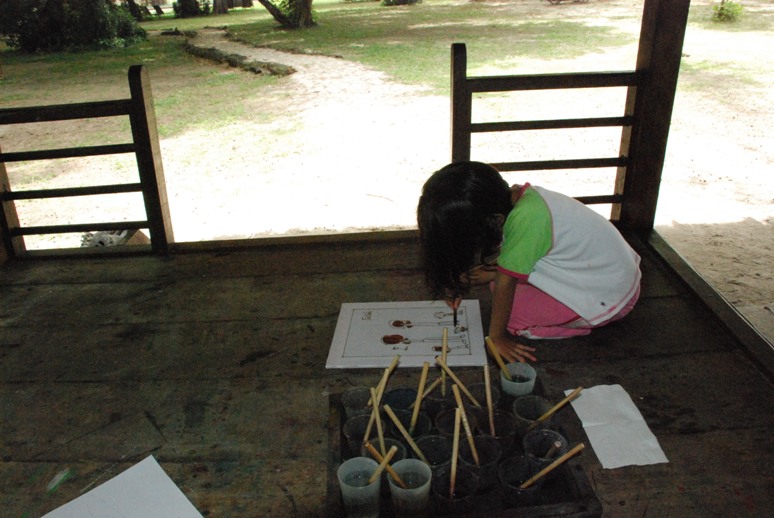
Tanjung Rhu Resort has a very nice art class centre that can teach participants the art of batik painting and wood carving. Here, my two kids are trying their hands at batik painting for the first time.
The resort's resident woodcarver is very good. Below are some of his work.
The woodcarver at work.
He is using the sample flower as his inspiration.
Was told that a lot of the wood carvings at the resort was done by this man.
TO BE CONTINUED.
Pictorial Journal on my family holiday to Tanjung Rhu, Langkawi - March 2008 - Part 01
Pictorial Journal on my family holiday to Tanjung Rhu, Langkawi - March 2008 - The hotel room and the environment - Part 02
Pictorial Journal on my family holiday to Tanjung Rhu, Langkawi - March 2008 - Cable car ride on Mount Cincang - Part 03
Pictorial Journal on my family holiday to Tanjung Rhu, Langkawi - March 2008 - Swamp cruise - Part 04
Pictorial Journal on my family holiday to Tanjung Rhu, Langkawi - March 2008 - Eagle feeding - Part 05
Pictorial Journal on my family holiday to Tanjung Rhu, Langkawi - March 2008 - Caving with a boat - Part 06
Pictorial Journal on my family holiday to Tanjung Rhu, Langkawi - March 2008 - Fish Farm - Part 07
Pictorial Journal on my family holiday to Tanjung Rhu, Langkawi - March 2008 - The SPA - Part 08
Pictorial Journal on my family holiday to Tanjung Rhu, Langkawi - March 2008 - Visiting a cave complex - Part 09
Wednesday, February 1, 2012
Book Review: Das Afrika Korps: Erwin Rommel and the Germans in Africa, 1941-43
Book Description
Publication Date: April 1, 2010
This action-packed history of the Germans in Africa in World War II covers one of the most famous military units of all time under one of the best commanders.
Bought this book from Amazon for USD26.95. Below is a review from Sci-fi and history reader (NJ, USA) that sums up my views about the book.
-------------
Franz Kurowski's narration of the German perspective on the fight for North Africa in World War Two reads quickly in this book. The primary focus is on the fight prior to Tunisia and provides a general overview. Von Mellenthin's Panzer Battles provides greater detail on the operational and strategic fight during his time there.
This book is a good introduction for those seeking to learn about the battles in North Africa. A key point to this book is how critical logistics (fuel and water) is to the success in desert warfare. Rommel's panzer forces simply did not have enough supplies, equipment, and most importantly tanks, to survive the attritional battle to attain victory. The key to the Allied success was the convoy interdiction at Malta that prevented German reinforcements and replacements.
The book does describe the Italian effort and gallantry while fighting under Rommel's command. Rommel did have his weakness in being overly aggressive in sending his overextended and understrength units to attack numerically superior Allied forces. In one case, this resulted in the destruction of an entire German battalion against the motivated and hardened Australian 9th Infantry Division at Tobruk. Had Rommel been more patient in attacking fixed locations, those setbacks could have been avoided.
Rommel's brilliance was in the defense/ counterattack and his knack for directing the tactical battle at the key moment. Even after the Battle of El Alamein, where the British started with approximately 1,000 tanks to the roughly 200 German tanks, Rommel and his key leaders were able to prevent their Army's destruction while retreating to Tunisia.
Overall this is good book to borrow from the library. Kurowski's Ace's series of books is more entertaining to read and own.
Tuesday, January 31, 2012
Book Review: Jump into Hell: German Paratroopers in World War II
Book Description
Publication Date: January 1, 2010
For the first time in English, this action-adventure narrative about elite German airborne troops covers recruitment, organization, training and combat on all fronts.
Bought this book from Amazon for USD27.21 (hardcover). It was a very good book. Anyway, below is a review from one reader, David L. Poremba "the past in review" (Windermere, Florida) that sums up what I feel about the book.
--------------
German World War II veteran Kurowski does for the paratroopers what he has done previously for other branches of the German Armed Forces - recount their complete battle history from the small unit viewpoint in an informative narrative, replete with first-person accounts.
Beginning with the formation of airborne forces, Kurowski describes the proposed World War I drop by American forces led by General Billy Mitchell (which never occurred as it was scheduled for 1919). He then moves to the Russians, who were developing their airborne tactics as early as 1923. During the same time period, he states that the Germans were acquainted with the idea of airborne envelopment but it remained in the theoretical stage until the mid-1930's, when the Fallschirmjager was established and kept secret until the invasion of the Lowlands in 1940.
The main event in Jump Into Hell is the large scale paratroop drop onto the island of Crete in May, 1941. Although the Germans eventually secured the island, casualties were so high that Adolf Hitler forbade any more massive drops. The chapter on the campaign in Russia, followed by Sicily and Italy to the end in 1945.
Based on eyewitness interviews after the war, Jump Into Hell is an excellent history of one of Germany's elite fighting units.
Subscribe to:
Posts (Atom)