Search this Blog & the WWW

Pages

Showing posts with label Technology. Show all posts

Friday, July 4, 2014

NU Sentral: SAM's Groceria is the supermarket at NU Sentral

At the first floor of NU Sentral is SAM's Groceria. The main supermarket at NU Sentral.


This supermarket has a Self Scan system in place which is the first I've seen in Malaysia.


Friday, January 18, 2013

Current statistics on my solar power plant

Finally got access to the remote sensing facility that helps monitor my solar power plant on top my roof. The current statistic looks good. For the past month, the plant was able to generate1,364.9 kWh of energy and contributed RM1,833.35 into my bank account! The best information is that I help reduce 955.4 kg of CO2 emissions into the atmosphere. Hooray for Mother Earth!


Thursday, December 27, 2012

A handheld Torch That Cuts Through Steel

Saw this article in Popular Mechanics. Scary piece of equipment!
------------------------------------

An offshoot of a military project, the Metal Vapor Torch could allow law enforcement officers to cut chains and padlocks fast.

The Metal Vapor Torch might be the next best thing to a lightsaber: a belt tool that can generate a blade of flame that slices through a half-inch steel bar in less than a second.


Energetic Materials & Products, Inc. of Round Rock, Texas designed the MVT as a tactical breaching tool for police and others who need to cut through bolts, chains, and padlocks quickly. By using reactive material technology with solid fuel and an oxidizer, the MVT is cheaper, lighter, and more compact than a traditional oxy–acetylene torch.

At the heart of the MVT is a reaction between copper oxide and precisely graded particles of magnesium and aluminum; consistent particle size is crucial to ensure that the torch burns at the desired temperature. The result is a jet of flame with a temperature over 2700 C (nearly 5000 F) and a speed of over 2000 meters (more than a mile) per second. A rectangular carbon fiber nozzle shapes the jet into a flat blade for cutting. The jet has higher energy density than a gas flame; the cutting action is produced by a combination of heat and abrasion by particles of metal oxide.

The MVT is the size of a tactical flashlight and is quiet in operation. The fuel comes in small cartridges which burn for a couple of seconds; a fresh cartridge can be loaded rapidly so the operator can cut through several obstacles in quick succession, and the torch handle can be reloaded and used as many times as needed. The solid fuel is highly resistant to shock and is safe at temperatures up to 550 C (1022 F). 


Dennis Wilson, the CEO of EMPI, says that the torch will be priced at around $135, with the intent that it be affordable enough to be supplied to every member of a police team. Cartridges will be about $35 each. The first preproduction version of the MVT will ship later this year, and feedback from users will help shape the final production model, Wilson says.

EMPI has also developed other versions of the MVT. For instance, the design can be scaled up, and Wilson has tested larger versions capable of cutting through inch-thick steel. The MVT could be equipped with fuel cartridges that incorporate abrasive additives for cutting through fiberglass. An alternative round nozzle could punch holes rather than cutting straight lines.

The MVT—which is a spinoff from work done by the U.S. Air Force—would be useful for first responders who need to cut through rebar to rescue accident victims. It works as well underwater as it does in air, making it suitable for divers, and it can be triggered remotely, or used by a robot, to swiftly disarm IEDs without setting them off.

Criminals could also easily misuse it—which is why Wilson says the MVT will be supplied to approved customers only.


Wednesday, December 5, 2012

SpaceX Founder Hopes to Establish a Large Colony On Mars Read more: SpaceX Founder Elon Musk Hopes to Establish 80,000 Person Colony On Mars

Article from: http://inhabitat.com/spacex-founder-elon-musk-hopes-to-establish-80000-person-colony-on-mars/

Earlier this year, Musk’s SpaceX company set a milestone in space exploration when it sent the first private unmanned spacecraft to the International Space Station. With cut-backs in government spending on space exploration, SpaceX has a sizable niche to fill – and in the past Musk made no secret of his intent to send craft (and people) to Mars.


He elaborated on these ideas in his lecture to the Royal Aeronautical Society. In a summary of his plans he suggested that early flights would consist of 10 people or less, carrying larger amounts of supplies. But once a colony and flights are established there would be the possibility of transporting 100 people or more at any given time—and he believes that there would be enough individuals interested in selling their earthly possessions and moving to Mars to make a reasonable business case for the missions.

Musk also noted another case for establishing an Martian colony; “[t]here’s 7 billion people on Earth, we’ll probably reach about 8 billion this century and the world as a whole is getting richer,” he explained “so I think if even one in 10,000 people decided to make the move, or one in 100,000,” then such a colony could be viable.


Monday, December 3, 2012

My solar power project finally went on-stream on 26 November 2012

After 11 months, my solar power project went on-stream on 26 November 2012. It was an exciting day as I can finally see the benefit of renewable energy working firsthand. The inspection by the staff of the electricity company went smoothly and after putting in all the security locks on the meter (to minimise the possibility of tempering), the power was switched on. In a small part, I am now helping the environment.

Below is the meter installed prior to switching on.


Below are some of the links to blog postings I made about this journey:

  1. http://meoramri.blogspot.com/2012/09/my-home-solar-energy-project-is-now-at.html
  2. http://meoramri.blogspot.com/2012/09/the-final-assembly-of-my-home-solar.html
  3. http://meoramri.blogspot.com/2012/02/brand-of-solar-cells-to-be-incorporated.html
  4. http://meoramri.blogspot.com/2012/02/i-am-going-into-solar-power-generation.html
  5. http://meoramri.blogspot.com/2012/02/paper-advert-on-solar-power-project.html
Below is the converter, the heart of the whole solar power generating system. This is the machine that converts the DC generated by the solar panels to AC and harmonised the frequency of the AC to the national grid. If you can see from the display panel in the picture below, the system was generating the first KwH into the national grid (reading 0.851 KwH).


Quite proud about this achievement. Faced a lot of problems with regards to bureaucracy as well as the negotiations on the Power Purchase Agreement. On hindsight, it was worth it.

Friday, November 30, 2012

A Brief History of the Steam Engine

This is taken from: www.popularmechanics.com. Please note that some of the images may not be generated by the document viewer. Please download the full PDF to get the full details.

Print - A Brief History of the Steam Engine - Popular Mechanics


Monday, November 26, 2012

Some very important DIY tips that everyone should know

This is taken from: www.popularmechanics.com. Some of the images may not be rendered properly. Do download the complete PDF file if you find problems viewing the document via the viewer.

Print - Know Your Stuff the 110 Best DIY Tips Ever - Popular Mechanics


Wednesday, October 10, 2012

Turn Your iPad into a Robot

Saw this article from the Times (See: http://techland.time.com/2012/08/14/double-robotics-lets-you-turn-your-ipad-into-a-telepresence-robot/). Very cool concept.
-------------------------------------

Tired of having to go places? Do you secretly wish you were a robot? Then a telepresence robot might just be the thing for you.


Previously, telepresence robots were fairly expensive and mostly aimed at wealthy tech entrepreneurs and people with disabilities who couldn’t leave their homes. Double is different.

At $1,999 for pre-orders and $2,499 after that, it’s expensive but not completely out of reach and it works with a piece of technology that’s fairly popular right now — the iPad.

Well, two iPads, actually. One is set in the adjustable stand to serve as your eyes and ears, while the other you use to control the robot with an app. The whole thing moves around on balancing wheels and kind of looks like a skinny Segway.

The company that makes it, Double Robotics, says it weighs only 15 pounds and is fully functional once you open the box and plug in your iPad. If it works like the company says it does (the first units don’t ship until December), it’ll be a big step in actually making robots accessible to the general public.

Double Robotics isn’t the only one to incorporate common consumer products into its robots. The initially Kickstarter-funded Romo by Romotive lets you plug your iPhone or Android phone into a dock with wheels and drive it around, letting you see whatever the robot sees. Downloadable apps will add new functionalities in the future.

Romo, however, comes in at an affordable $149. It’s hard to see too many people spending more than $2,000 on a telepresence robot just for the hell of it. But as Double Robotics points out its website, it’s definitely within the price range of a museum that wants to let people explore its collection from home or a company that wants to keep tabs on its overseas factories from its headquarters.


Read more: http://techland.time.com/2012/08/14/double-robotics-lets-you-turn-your-ipad-into-a-telepresence-robot/#ixzz28fsjzevS


Friday, September 28, 2012

What is redshift?


  • The term "redshift" arises from the fact that light from more distant objects shows up on Earth more red than when it left its source
  • The colour shift comes about because of the Doppler effect, which acts to "stretch" or "compress" waves from moving objects
  • It is at work in the sound of a moving siren: an approaching siren sounds higher-pitched and a receding one sounds lower-pitched
  • In the case of light, approaching objects appear more blue and receding objects appear more red
  • The expansion of the Universe is accelerating, so in general, more distant objects are moving away from us (and each other, and everything else) more quickly than nearer ones
  • At cosmic distances, the shift can profoundly affect the colour - the factor by which the wavelength is "stretched" is called the redshift


Friday, September 21, 2012

Hammacher Schlemmer's flying hovercraft

This is the hovercraft that glides over land and water yet also soars in the air up to 70 mph with the aid of integrated wings. A 130-hp twin-cylinder, liquid-cooled gasoline engine -- turbocharged and fuel-injected -- drives its 60" wood/carbon composite thrust propeller while a 1,100-rpm 34" lift fan inflates its durable vinyl-coated nylon skirt for hovering above the ground.


Operating in fresh- or saltwater and up to 30% inclines over sand, mud, grass, swamp, desert, ice, and snow, its wings and horizontal elevator enable pilots to simply hop over water- or land-based obstacles up to 20'-high unsurmountable to a typical hovercraft.


A joystick controls three vertical rudders and the elevator, a twist friction-lock throttle controls forward speed, and a variable drive system controls the lift fan for hovering. Braking is provided by lowering the lift fan's rpms; comes to rest on Kevlar composite landing skids.


Its low center of gravity and composite fiberglass/PVC hull enable it to operate in winds up to 25 mph and waves up to 6' when in flight. Two nine-gallon gasoline tanks provide a 160-mile range. Supports pilot/passenger payloads up to 600 lbs. for flight.


I am a bit surprised by the price list. The listing is USD190,000 but based on the photos, it doesn't look USD190,000 worth of stuff. I bet you can build one for just USD19,000 tops.

Wednesday, September 19, 2012

You can now buy jetpacks

Since Bell Labs built the first rocket belt in 1953, two major problems persists that stops potential buyers from getting one: Rocket belts are not for sale, and there is only enough fuel to stay aloft for under a minute.

Mexican company, Tecnologia Aeroespacial Mexicana (TAM) offers its custom-built TAM Rocket Belt for $250,000, which includes flight and maintenance training. On a full tank of hydrogen peroxide the belt weighs 124 to 139 pounds and provides 30 seconds of flight. TAM's sole competitor is Jetpack International, a Colorado-based company. Its hydrogen-peroxide-burning Jet Pack H202 can stay in the air for 33 seconds, 3 seconds longer than TAM's model. The H202 weighs 139 pounds, and is competitively priced at $155,000, flight classes and all.

TAM ROCKET BELT MODEL JET PACK H202
More than 60 mph TOP SPEED 70 mph
30 seconds FLIGHT TIME 33 seconds
$250,000 PRICE $155,000

Tuesday, August 7, 2012

Video by NASA on the landing sequence of the Mars Curiosity rover

Yesterday, the Mars Curiosity rover — the $2.5 billion, six-wheeled lab that’s the latest brainchild of NASA’s Jet Propulsion Laboratory (JPL) in Pasadena — touched down on Mars.

This video from NASA shows the technology used to land the rover on Mars. Just brilliant.


Tuesday, July 3, 2012

Shape of cars to come

Very impress the speed of technology. Saw this entry by the Economist regarding the shapes of cars to come. Have a read.

----------------------------------------------------


See: http://www.economist.com/blogs/babbage/2012/06/motor-racing?fsrc=scn/tw/te/bl/shapeofcarstocome

TO NO-ONE'S great surprise, Audi dominated last weekend's 24-hour endurance race at Le Mans, in the bucolic Loire district of France. A hybrid version of its R18 sports car took the chequered flag—the first time a hybrid, from any manufacturer, won at Le Mans. Another Audi hybrid came second, and the company claimed third and fifth with a pair of turbo-diesels. Toyota returned to the race after a 13-year absence with two hybrids of its own—only to see one crash and the other retire with mechanical problems.

Though a novelty, the hybrids were not the stars of the show. A tiny triangular-shaped car known as the DeltaWing was giving the other 55 fire-breathing machines a run for their money when it was unceremoniously bumped off the track and into the crash barrier by one of the Toyotas. So ended a brave attempt to show that a car with half the weight, half the horsepower and half the aerodynamic drag could run rings round the dreadnoughts of the sport.


It was not the first time that a radical, lightweight design has challenged conventional thinking in motor racing. Something similar happened when Colin Chapman’s featherweight Lotus 23, with Jim Clark at the wheel, made its debut at the Nürburgring’s infamous northern loop in 1962. With its tiny 100 horsepower motor (a third that of its rivals), the Lotus 23 shot ahead of the field of ponderous Porsches, Aston Martins and Ferraris. After one lap of the rain-soaked track, Clark was 27 seconds ahead of the leading Porsche driven by the American ace, Dan Gurney. The world of motor racing had never seen anything like it before.


The following month, when two Lotus 23 cars—one with a 750cc engine and the other with a 1,000cc unit—were entered for the Le Mans endurance race, French officials promptly banned them for being too good. Chapman swore never to enter a Lotus car for the 24-hour Le Mans race ever again—and kept his promise till the day he died.

More than in any other motor sport, engineering improvements made to meet the gruelling demands of endurance racing feed directly into everyday motoring. Unlike Formula One cars or their IndyCar cousins, where teams focus on making vehicles that run furiously for a few hours, endurance events like Le Mans are more about building sporty but reliable machines that can run flat out for a full 24 hours, with only brief pit stops to take on fuel, replace worn tyres and swap drivers.

Also, much of the Le Mans circuit (officially known as Circuit de la Sarthe) is made up of public roads that are used for the rest of the year by cars and camions. Le Mans requires drivers to cope with rough, cambered surfaces as bone-jarring as anything everyday motorists face. To compete successfully, Le Mans cars have to be not only robust, but also have good fuel economy and be extremely stable, especially at high speed.

Long, fast straights dominate the Le Mans circuit. Because drivers were reaching 250mph (400km/h) before hitting the brakes for the sharp turn at the bottom of the three-mile (five-kilometre) downhill Mulsanne straight, two sets of chicanes were added in 1990 to slow the cars down. Even so, Mulsanne remains a savage test for aerodynamic stability. In 1999, a Mercedes-Benz CLR became airborne while hurtling down it, flying spectacularly over the safety fencing before landing in the woods beyond. That was not the first time. The CLRs had flipped twice during practise. Fortunately, no one was seriously hurt.

But the stability problems were enough to make Mercedes-Benz withdraw from the race and abandon its entire sports-car programme before further accidents could tarnish its public image. Last weekend, after being hit by a Ferrari, one of the Toyota hybrids also took to the skies before slamming into a tyre barrier at the bottom of the Mulsanne straight, fracturing two vertebrae in the driver’s spine.

Such are the perils of relying on aerodynamic downforce for high-speed stability. Any interference, whether a nudge from another vehicle or a bump in the track, can upset the airflow over the car, especially on the wing at the rear that creates the bulk of the downforce. The car will often "porpoise", as the rear wing stalls and air pressure builds up under the nose, sending the vehicle tumbling end over end.

The little DeltaWing car at this year’s Le Mans aimed to do things differently. Conceived by Ben Bowlby, a British-born racing-car designer, and built by Dan Gurney’s All American Racers as a contender for the 2012 IndyCar Series, the DeltaWing carried no external wings, because of their propensity to generate drag along with downforce. Instead, the car got most of its downforce from the underside of the body.

To reduce drag still further, the DeltaWing’s frontal area was made as small as possible. The front wheels were spaced just two feet apart, while the track at the back was a more conventional five-and-a-half feet. The result was a car with superior straight line and cornering speeds, and much better fuel economy than any of the IndyCars it was designed to replace.

Another feature of the delta layout is the way the wing’s leading edges generate strong vortices that energise the air flowing over the rest of the wing. That keeps the airflow attached more effectively to the surface, allowing the wing to sustain much higher angles of attack before stalling. Used on a racing car, with the lifting surface beneath the vehicle and pointing down, the vortex effect can be used to keep the vehicle glued to the ground.

Though Mr Bowlby’s novel design was deemed too radical for the IndyCar Series, his car was invited to participate in this year’s Le Mans race as a “Project 56” entrant. Apart from the 55 cars that qualify to race each year, the organisers reserve one extra slot on the grid for a car considered so innovative that it should be allowed to compete without having to comply with the rules.

With its 1.6 litre, four-cylinder Nissan engine, the DeltaWing was far from the most powerful machine on the grid. However, like the featherweight Lotus all those years before, it tipped the scales at just half the weight of the big Audis and other “prototype” sports cars in the race. That let it produce a similar power-to-weight ratio of 600-700 horsepower per ton, but with a drag coefficient of just 0.24 compared with the 0.47 of the all-conquering R18s. What the diminutive DeltaWing lost in outright speed, it gained by not having to go into the pit so often to change tyres and refuel.

So popular was the little DeltaWing with fans that when it was forced into the crash barrier by a Toyota driver who did not see it creeping cheekily alongside, the number of people listening to the race commentary on Radio Le Mans fell by 30%. Will it race again? Probably. But most likely under different management. Mr Bowlby designed the DeltaWing as an open-source project, so other teams could build their own versions to race.

Monday, June 18, 2012

30-Floor Building Built In 15 Days - Video of the construction process

Saw this video of a 30 floor building completed in 15 days using pre-fab materials. Just brilliant.


Monday, May 28, 2012

The PAL-V ONE flying car: For the James Bond wannabes


PAL-V ONE is a Dutch-designed personal 3-wheeler motorcycle/gyro-copter combo. Price (estimated) for a PAL-V ONE will be around $300,000. You do need a motorcycle license as well as a pilot license to use this. For more information on the PAL-V ONE, visit http://pal-v.com/


Below is a video of its first flight.

Wednesday, February 22, 2012

The brand of solar cells to be incorporated on top of my roof


After looking at the various options in terms of type of solar cells to be used in my project. I have decided to go with the Sanyo HIT Photovoltaic module. HIT stands for Heterojunction with Intrinsic Thin Layer. This technology is better suited for Malaysia's warm and humid climate compared to the European option. Below is the brochure for the Sanyo unit.

Catalog Hip-210nkh5 2

The other alternative is the Bosch Solar Module c-Si M 60 EU 30117. The brochure is given below.
Bosch Solar Module c Si M 60 EU 30117 Englisch Monitor

In terms of price difference, the Sanyo is considered the high-end unit compared to the Bosch.

Wednesday, September 7, 2011

First batch of suicide drones for the U.S. Army

Small size, quiet motors let aircraft find target, sneak in and deliver knockout blow.

The backpack-size "Switchblade" drone and its launch tube give individual soldiers a new level of precise control over an explosive weapon.


Soldiers who fly hand-launched drone scouts to spot enemies on the battlefield may soon get a deadly robotic device capable of also delivering a knockout blow. The U.S. Army has ordered its first batch of small suicide drones that are capable of launching from a small tube, loitering in the sky and then diving at a target upon command.

The backpack-size "Switchblade" drone and its launch tube give individual soldiers a new level of precise control over an explosive weapon. Rather than calling in supporting artillery fire or airstrikes, soldiers can simply launch the Switchblade from out of sight, confirm a target on a live video feed from the drone, and then command the robotic device to arm itself and fly into the target at high speed.

"The unique capabilities provided by the Switchblade agile munition for standoff engagement, accuracy and controlled effects make it an ideal weapon for today's fight and for U.S. military forces of the future," said Bill Nichols, deputy product director at the Army's Close Combat Weapons Systems project office.

Operators can even call off strikes at the last second after arming the Switchblade. That kind of control allows soldiers to retarget in case an enemy moves out of sight, or avoid collateral damage if a civilian wanders too close.

The drone, created by AeroVironment, is able to fly in both autonomous robot mode or as a remotely piloted air vehicle. Either way, its small size and quiet electric motor allow it to approach targets without warning. It can even switch off its motor and glide in for a stealthy attack.

"Just as our small unmanned aircraft systems provide game-changing reconnaissance capabilities to ground forces, Switchblade provides a revolutionary rapid strike capability to protect our troops and give them a valuable new advantage on the battlefield," said Tom Herring, AeroVironment senior vice president and general manager of Unmanned Aircraft Systems.

AeroVironment received a $4.9 million contract from the Army's Close Combat Weapons Systems on June 29. The company publicly announced the deal on Sept. 1.

Article from : http://www.msnbc.msn.com/id/44412133/ns/technology_and_science-innovation/#.Tmbr6mqAYdU

Friday, August 26, 2011

Flying solo

Saw this article from Popular Mechanics. Wouldn't it fun if we can get one of them and take to the sky?


Neither one is quite George Jetson's jet pack, but these two new ultralight helicopters are about as bare-bones as a flying machine can get: an engine to spin two sets of rotor blades, and a chair hanging underneath. The key to the AirScooter II and the Gen H-4 is mounting two blades on the same axis and rotating them in opposite directions to counteract each other's torque, eliminating the need for a tail rotor.

Both designs meet the FAA's rules for ultralight aircraft: a top speed of just over 60 mph and a 5-gal. gas tank, for about an hour of flying. That means you don't need a license to own or fly one. "Initially, our plan was to keep the thing really low to the ground," says AirScooter president Dwaine Barnes. But you can't give a man a helicopter and tell him not to soar, so both models can be equipped with a ballistic parachute.

If we have to pick just one, the AirScooter seems like the safer bet. Its big engine and pneumatic floats make it look rugged and downright stable compared to the Gen H-4's spindly aluminum piping. Now, if we can just scrape together $50,000.

AIRSCOOTER II
AVAILABILITY: Production starting in 2007.
PRICE: Around $50,000
WEIGHT: Under 254 lb.
LOAD: About 350 lb.
ENGINES: One 65-hp, four-stroke engine.

GEN H-4
AVAILABILITY: Home-assembly kit (30 to 40 hours) available now.
PRICE: $30,000
WEIGHT: 155 lb.
LOAD: Up to 200 lb. — bigger engines are being developed to carry bigger pilots.
ENGINES: Four independent 10-hp, two-stroke engines — and it can fly safely on three if one conks out.

Tuesday, August 16, 2011

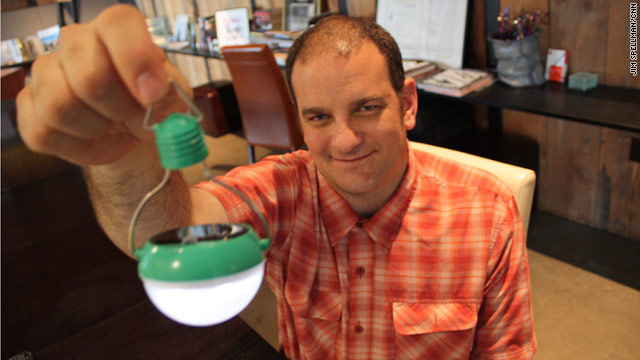
Solar light bulbs


Denver (CNN) -- It started with such a simple concept: A solar light bulb that charges up during the day and lights the night when the sun sets.


Inventor Steve Katsaros perfected his design in June 2010, and four days later he had a patent in hand.

He knew it was a good product, but he didn't know what to do with it.

"It wasn't until after we created it that we asked ourselves, 'How do we market this,'" Katsaros says. "And we learned that the largest market was the developing world."

SEE FULL ARTICLE FROM CNN BY CLICKING ON THIS LINK

Friday, July 15, 2011

What does "Jewels" means in a mechanical watch?

Partial answer from Wikipedia:


The movement of a chronograph pocketwatch from the 1880s.


Jewel bearings were invented and introduced in watches by Nicolas Fatio (or Facio) de Duillier and Pierre and Jacob Debaufre around 1702 to reduce friction. They did not become widely used until the mid 19th century. Until the 20th century they were ground from tiny pieces of natural gems. Watches often had garnet, quartz, or even glass jewels; only top quality watches used sapphire, ruby, or diamond. In 1902, a process to grow artificial sapphire crystals was invented, making jewels much cheaper. Jewels in modern watches are all synthetic sapphire or (usually) ruby, made of corundum (Al2O3), one of the hardest substances known. The only difference between sapphire and ruby is that different impurities have been added to change the color; there is no difference in their properties as a bearing. The advantage of using jewels is that their ultrahard slick surface has a lower coefficient of friction with metal. The static coefficient of friction of steel-on-steel is 0.58, while that of sapphire-on-steel is 0.10-0.15.


Why they are used

Jewels serve two purposes in a watch. First, reduced friction can increase accuracy. Friction in the wheel train bearings and the escapement causes slight variations in the impulses applied to the balance wheel, causing variations in the rate of timekeeping. The low, predictable friction of jewel surfaces reduces these variations. Second, they can increase the life of the bearings. In unjeweled bearings, the pivots of the watch's wheels rotate in holes in the plates supporting the movement. The sideways force applied by the driving gear causes more pressure and friction on one side of the hole. In some of the wheels, the rotating shaft can eventually wear away the hole until it is oval shaped, and the watch stops.

http://en.wikipedia.org/wiki/Mechanical_watch

LinkWithin

Related Posts with Thumbnails